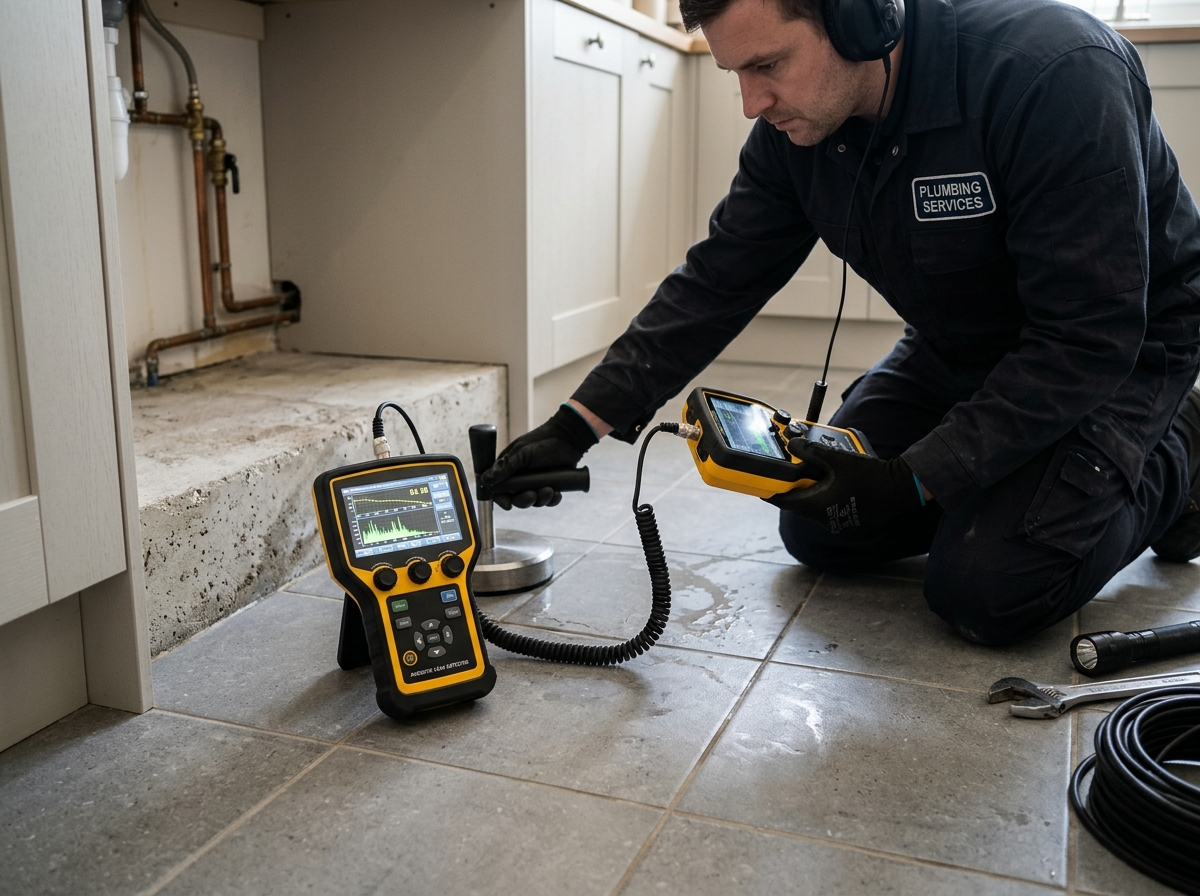
Precision Diagnostics: Why Non-Invasive Detection Matters
When pressurized water breaches a supply pipe buried under a concrete foundation, breaking up flooring indiscriminately is both expensive and destructive. In Santa Fe residences featuring handcrafted saltillo tiles, flagstone entries, polished concrete, or custom hardwood, exploratory jackhammering causes irreversible damage. Professional slab leak detection Santa Fe replaces destructive exploration with calibrated scientific measurement.
By coupling advanced acoustics with high-sensitivity thermal scanning and electromagnetic line tracing, an experienced technician can pinpoint the exact breach coordinates to within a single tile. This precision preserves historic Santa Fe architectural elements and provides the technical clarity necessary to choose between a targeted spot repair or an overhead line reroute through slab leak repair in Santa Fe.
Key Warning Signs and the Homeowner Water Meter Test
Recognizing the initial signs of an underground rupture allows homeowners to intervene before soil subsidence damages stem walls. Look out for unexplained moisture along baseboards, warm spots underfoot, unexplained humming in your plumbing, or a sudden spike in municipal utility billing.
Homeowners can perform an initial, straightforward verification using their water meter:
- Turn off all interior faucets, outdoor hose bibs, automatic ice makers, and evaporative cooler valves.
- Verify that toilets are not running or refilling.
- Locate your City of Santa Fe water meter box, usually positioned near the street or property boundary.
- Observe the low-flow indicator dial (often a small triangle or star gear) or read the digital digital display.
- If the indicator continues spinning or digital consumption accumulates after ten minutes with all fixtures off, a continuous pressurized breach exists on the property. A professional slab leak test Santa Fe is required to isolate whether the failure is under the foundation or on the exterior supply line.
Our Comprehensive Diagnostic Testing Protocol
Accurately identifying an under-slab failure requires a methodical, multi-stage diagnostic process using calibrated professional tools:
1. Manifold Pressure Isolation: Hot vs. Cold Lines
Technicians attach precision digital pressure gauges directly to the plumbing manifold or water heater drain. By valving off individual sections of the system, we isolate the cold potable line network from the hot domestic supply. This identifies immediately which circuit cannot sustain static municipal pressure, narrowing down the search parameters.
2. Electronic and Acoustic Leak Detection
High-pressure water escaping through a fractured copper joint creates distinct acoustic vibrations that propagate through concrete, soil, and pipe walls. Utilizing calibrated electronic leak detection Santa Fe equipment—including ground sensor microphones, resonant headphones, and acoustic frequency amplifiers—the specialist sweeps the floor surface to identify the highest decibel spike corresponding to the rupture epicenter.
3. High-Resolution Infrared Thermal Imaging
For hot water line breaches, thermal imaging provides an immediate, non-invasive visual map. Calibrated infrared cameras detect minute temperature variations radiating upward through concrete slabs, brick floors, and tile. The escaping hot water forms a distinctive thermal plume, allowing the technician to visualize the subsurface leak path without cutting into building materials.
4. Electromagnetic Line Tracing and Mapping
To safely perform any targeted repair or understand pipe paths for a reroute, the technician connects a low-frequency radio transmitter to the plumbing lines. A receiver wand traces the exact path, depth, and directional turns of the buried metal pipe across the floor plan. This comprehensive leak under slab detection Santa Fe ensures no guesswork takes place.
Why Precision Location Keeps Concrete Breaking to a Minimum
Traditional, outdated plumbing methods frequently involved cutting wide trenches across rooms in hopes of finding the leak through trial and error. In contrast, modern electronic pinpointing establishes the failure point within an area smaller than a dinner plate. If a direct concrete breakout is selected, the opening is kept minimal, protecting the structural integrity of your foundation, avoiding unnecessary dust contamination in high-desert adobe plaster, and simplifying floor restoration.
Furthermore, if testing reveals widespread pipe deterioration or multiple pinholes, precision diagnostics clearly justify selecting an overhead slab leak reroute or complete residential repiping rather than digging into concrete repeatedly.
What Your Written Leak Detection Report Includes
Following diagnostic testing, property owners receive a comprehensive, formal leak detection summary detailing every scientific observation. This report is vital for coordinating repairs and substantiating claims with insurance providers:
- Pressure Loss Measurements: Recorded psi decay readings demonstrating active failure in either the hot or cold supply circuits.
- Exact Failure Location: Physical description and floor plan markings indicating the precise room, coordinates, and depth of the subterranean breach.
- Thermal Imaging Scans & Acoustic Data: High-resolution thermographic images showing subsurface heat bloom, along with verified acoustic frequency logs.
- Line Tracing Overview: Documentation of pipe material, estimated pipe age, and structural routing characteristics beneath the slab.
- Technical Recommendations: Clear professional guidance on repair viability, detailing whether localized concrete breakout, an overhead PEX bypass, or line replacement is the most sound long-term strategy.
Next Steps After Locating Your Foundation Leak
Once the failure coordinates are established, homeowners have clear, actionable options. If the hot water circuit is the culprit, review our dedicated guide to hot water slab leak repair. If preserving finished floors is your highest priority, explore our non-invasive slab leak rerouting process. We also assist homeowners with technical reports for claims through our slab leak insurance support page, and serve all local communities described on our Santa Fe service areas page.